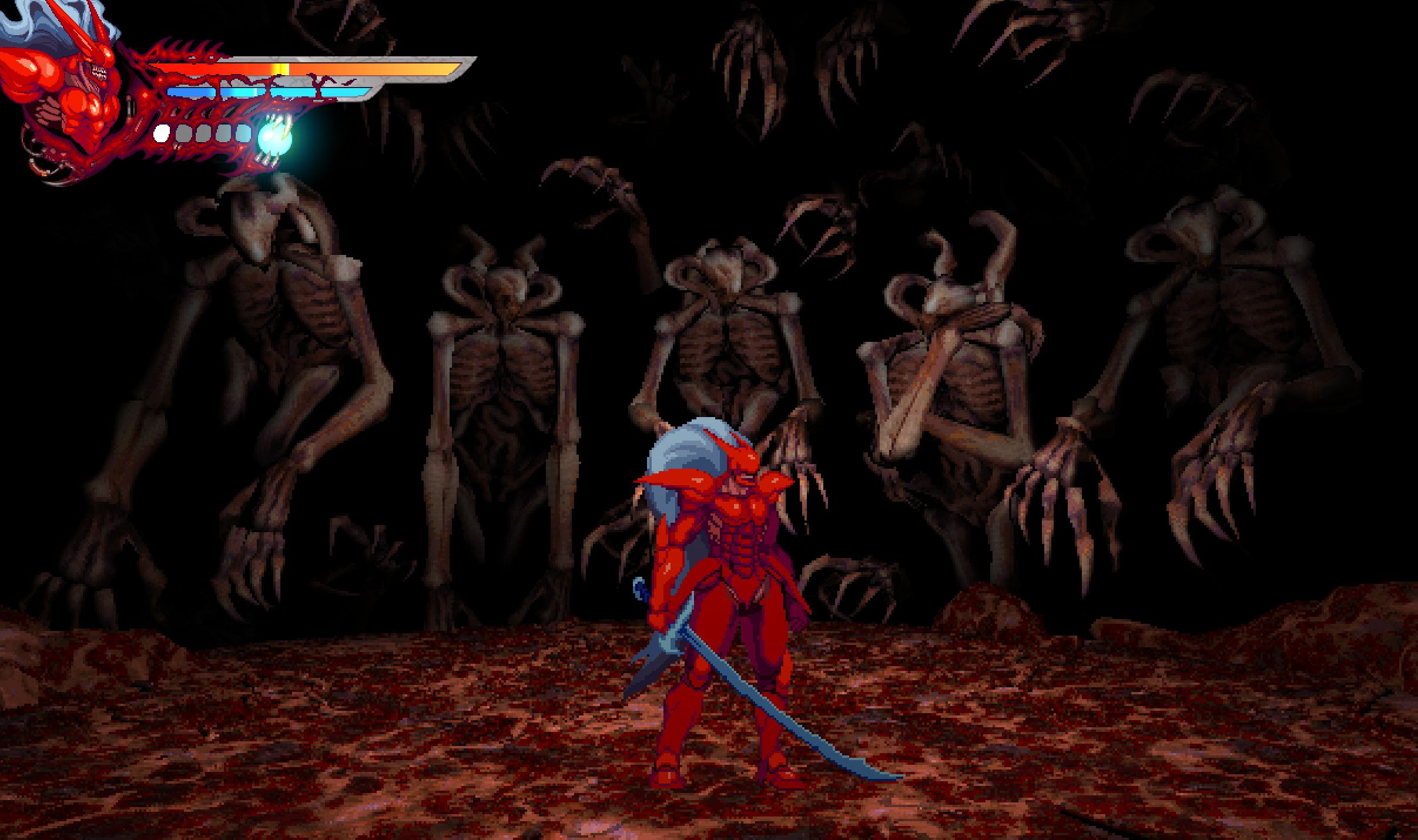
I worked on action-heavy beat ’em up Slave Zero X as a level designer in 2022. It was fast-paced, tough, yet ultimately one of the most exciting and personally rewarding gigs I’ve ever had. If you want to see what the game plays like, there’s a trailer below. The story follows a hero in a biosuit called Shou, on a mission to bring down a despot known as the “Sovereign Khan” (yes, it’s very anime).
Because this was a small team, I got the chance to work on level layouts from the greybox stage, and to take them right through the set dressing and polish stages, using countless retro assets made by others on the team. I worked on 11 levels out of 26 levels in the game. I don’t have screenshots or video for every one I worked on, and many levels saw several of us working on them, but on at least 5 or 6 of those I took the lead. Hopefully I can showcase a few things I’m happy with.
The lab

In this level, protagonist Shou discovers a laboratory that houses various monstrous beings. You can watch a playthrough of the lab levels in this longplay.
My main goal with the level was to create a very quickly rising sense of unease. The player has just escaped from a huge misshapen beastman called Uriel, and the script was foreshadowing another encounter. The level had to be freaky, and our art director Francine fully encouraged me to get slimy.

On an aesthetic level, this meant leading the player past various horrible vats and tubes. But on a practical level, the player would still need to be given many “stages” on which action (and the camera) could pause. This is a beat ’em up, after all.

My go-to approach was to break up the layout so that there were longer passages to run through, yet plenty of these isolated “stages”, where the background needed to be cool, but not overwhelming. I liked it, for example, when the background receded a lot into the distance, since that meant I could often create a vista, but fights in the foreground could still feel focused when our programmer and encounter designer Tristan filled the screen with enemies.
The refinery
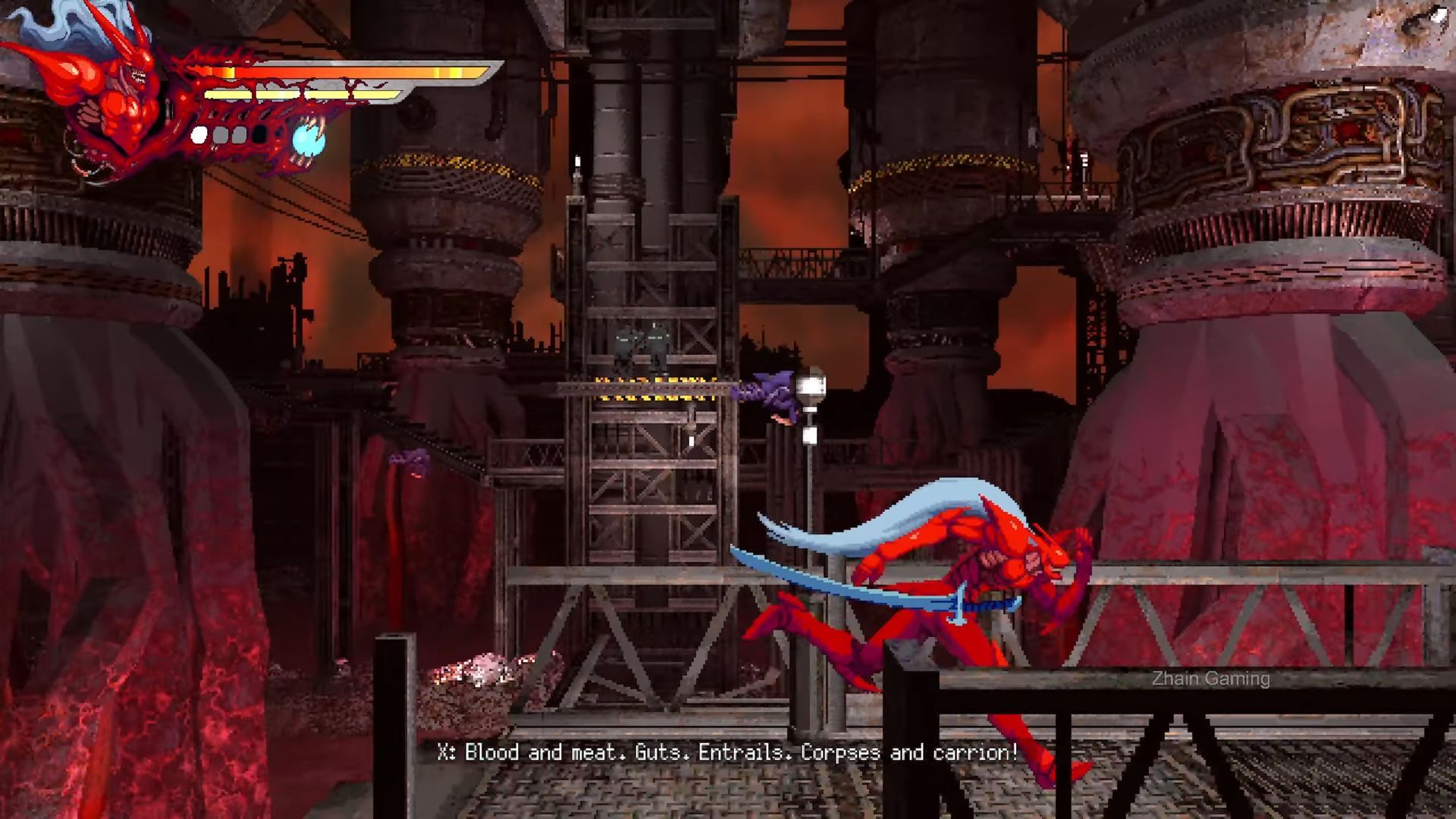
In this early level, Shou and the biosuit are making their way out of the toxic pits of the city. You can watch the stage in this longplay video.
The brief I was given was basically: industrial hell on an overcast day. I also got a very basic blockout. This was the first level I worked on. I don’t think it’s the best level in the game by any stretch, but it did teach me the most. For this one, I worked with a vast amounts of modular assets, perhaps much more than following levels.

I made it far too big, and due to boring technical reasons I constantly struggled to make the lighting work well as a result of its scale, even though our lead programmer Cass did a great job of improving the game’s initial lighting code. The lighting in the lower levels looks the best, with a red glow bouncing up from the surface of a toxic pool. But the higher you travel, the darker and murkier it gets.

This level also taught me some 2.5D action game design basics. I should try to turn corners at 45 degree angles or less, for instance, because hard 90 degree angles feel very sudden, and if they happen during a fight it can feel off. Likewise, I found that any rising or falling surface couldn’t be too steep, because we lacked the ability to animate a character running “uphill” or “downhill” on the fly. There are a lot of steps in this level, basically, and in later levels I tried to avoid that completely by using long piles of rubble, gently rising floor grates, or corridors that only rose a few steps at a time.

Basically, this was the level which reminded me – hard – that level design is all about how a body moves through space, that you must measure accurately, and that you should be happy to throw things away when they don’t work.
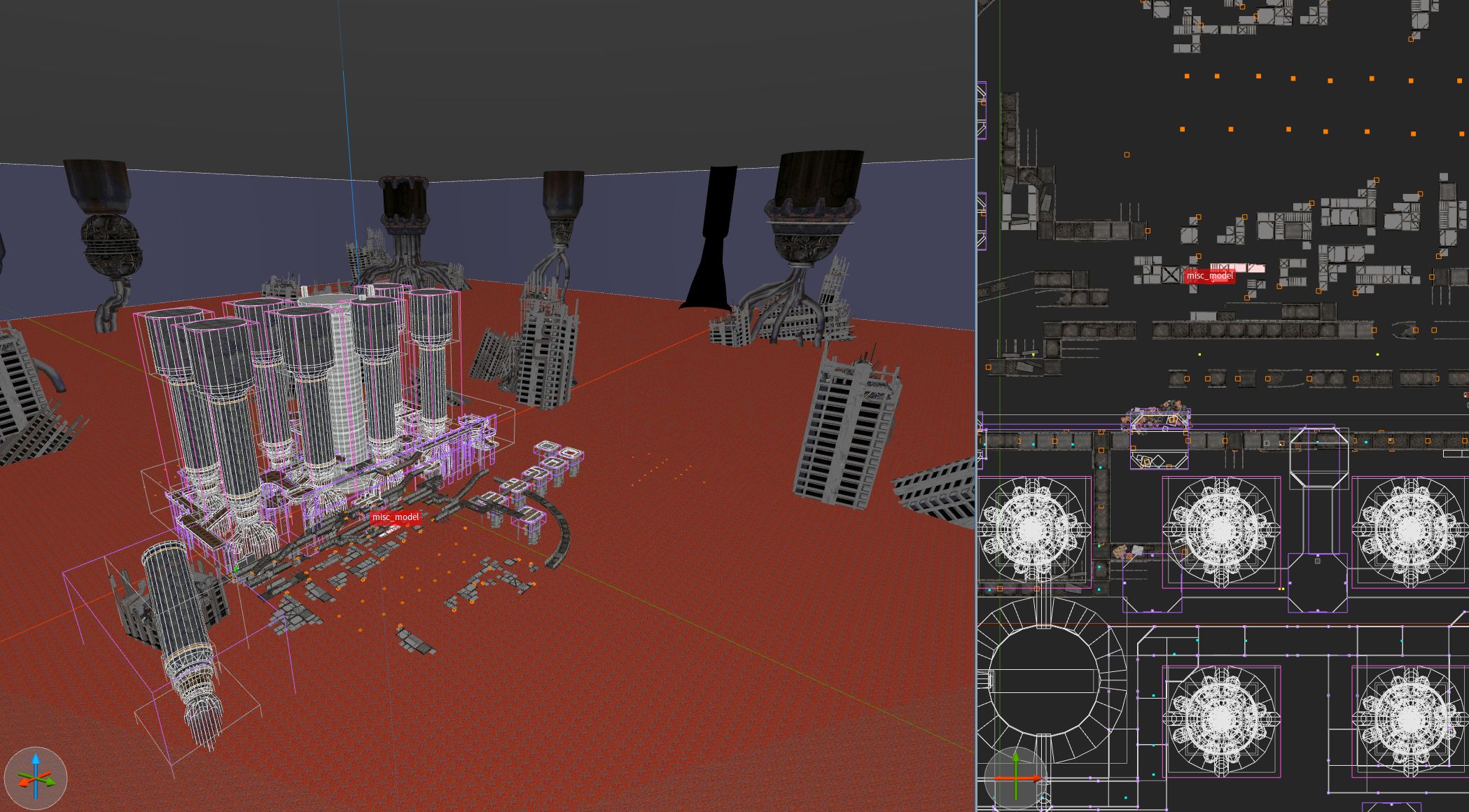
I don’t even know if this facility is really a “refinery” or not in the lore. But I like to call it that; it’s where I refined my process for all the maps that followed.
The library
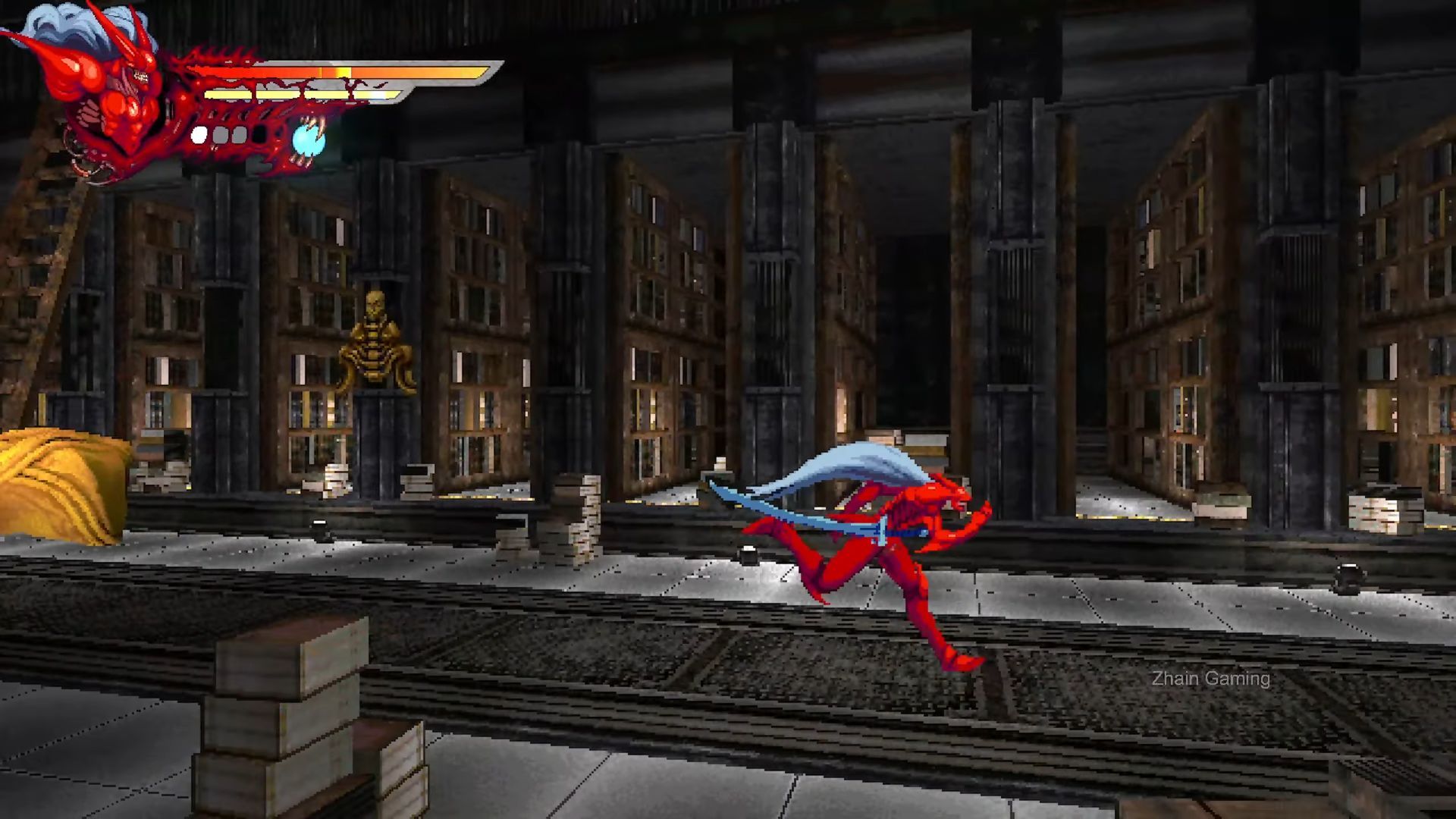
One boss encounter sees you running away from the aforementioned monstrous beastman, escaping through his library of hoarded books. This came about because I had originally designed a bonus level based on Trinity College library in Dublin. The team liked it a lot, and since we needed a long passageway for this particular chase sequence, it seemed sensible to repurpose the library as that corridor. Don’t worry, it makes sense for this monster to collect and read books, he’s a very educated freak.
Set dressing

Like I say, my job title was “level designer” and a lot of time was spent finessing layouts and creating geometry. But half my time was actually spent set dressing those same levels with all the assets and textures we were given. In a bigger team, that would be more of an environment artist role. But on a small team, you have to wear more than one hat. In this case, that prop-placing hat suited me just fine. I loved arranging scenes like this.

I would often be handed levels to polish, or to add “touch-ups”, which usually meant adding more detail to the world. A city street might need yellow lines on the road, graffiti on the walls, trash cans, barriers, rusted cars, broken windows, neon lights. The real heroes here are the environment artists like “Shotgun”, “Kebby” and others who made the retro PS1-era assets I could use. But I’m still proud of the way I put some of these scenes together.
A note on tools

This was an unusual project in the sense that we used some niche tools to make the game. My fellow level designers and I used Trenchbroom to create level geometry, and to texture that geometry. The programming team then used Gamemaker to put it all together. As a tool, Trenchbroom seems old fashioned (it’s used to make Quake maps) but it is astoundingly well-suited for quick and dirty level design. And can be used in conjunction with Godot or Unreal Engine – the latter of which I’ve experimented a fair bit.
The team
I’ve mentioned a few names throughout this, and that’s because I couldn’t have done my job properly without help from all of them. I worked with three other level designers – James Greenwood, Fabio Pereira, and Eber Nieto – and most levels saw at least two of us sharing the load and passing the map file back and forth, sometimes three of us. Producer Rose McKee did a huge amount of invisible work keeping me and others on track, she was the motor oil that kept our whole engine running. Art director Francine gave excellent and friendly advice, often drawing over screenshots to show us exactly what she meant – a massively helpful practice – as well as looking over levels and giving honest feedback that pushed me to improve, always in an encouraging way. Our programmers Kaylee, Cass, and Tristan were like the three oracles. I cannot count how many times they helped me understand the arcane madness that was whirring underneath it all. Russell the sound wizard, who had to meticulously place audio nodes in Trenchbroom and pray that none of us would move the entire level ten meters to the left. Animators Scott, Han, Barbara, and Liam who pumped out an obscene amount of combative critters in the time they had. I’m very glad I got to work with all these folks. You can see the full list of credits here.


 Brendan Caldwell